# Stakpak Vs AWS DevOps Agent

## Overview

{% hint style="success" %}
TLDR:

AWS DevOps Agent tells you what broke and what to do.

Stakpak goes further,  it fixes it (when safe) and can provision or change infrastructure.

Understanding isn’t the bottleneck anymore. Execution is.
{% endhint %}

Infrastructure isn’t changing at human speed anymore.

Agents can already read logs, trace dependencies, and figure out what broke in seconds.\
The real question is: what happens after that?

AWS DevOps Agent and Stakpak answer that differently.

AWS DevOps Agent focuses on understanding your infrastructure, investigating issues, identifying root causes, and telling you how to mitigate them.\
\
While Stakpak is open source, vendor neutral, and model neutral — but more importantly, it actually operates your infrastructure: provisioning, changing, monitoring, and safely auto fixing issues in production.

All of this runs behind production grade guardrails, with enforced policies, secret redaction, and full auditability.

## How They Compare

<table><thead><tr><th width="175.265625">Category</th><th width="326.41015625">Stakpak</th><th>AWS DevOps Agent</th></tr></thead><tbody><tr><td>Openness</td><td>Open Source</td><td>Managed (closed)</td></tr><tr><td>Works With</td><td>Any Cloud, Any Tool</td><td>AWS (+some integrations)</td></tr><tr><td>Model Support</td><td>Any model (BYO or hosted)</td><td>Managed by AWS</td></tr><tr><td>Provisioning</td><td>Creates &#x26; modifies infrastructure (with approval) + Generates IaC</td><td>Generates IaC / suggestions</td></tr><tr><td>Execution</td><td>Runs commands for you (with approval)</td><td>You run commands yourself</td></tr><tr><td>Incident Response</td><td>Monitor -> Alert -> Auto Fix What’s Safe</td><td>Monitor -> Alert -> Suggest Next Steps</td></tr><tr><td>Guardrails</td><td>IAM + <a data-mention href="../how-it-works/warden-guardrails">warden-guardrails</a></td><td>IAM</td></tr><tr><td>Auditability</td><td>Full Audability</td><td>Full Audability</td></tr></tbody></table>

## What Happens In Production?

Let’s take a real example

### Incident

Its 3am, and the OpenClaw gateway in production suddenly goes down. Health checks start failing,f from the outside, it’s just another incident, something broke. But what happens next depends entirely on the agent handling it.

Both systems detect the failure quickly and trigger alerts.

But it’s 3am. Your team is asleep.

No one is there to read the alert, or run the fix. Detection isn’t the problem anymore, execution is.

### Investigation

Then the agents start investigating.

They pull logs, check the service state, and trace what happened. The gateway didn’t crash, it received a SIGTERM, exited cleanly, and never restarted.

At this point, the root cause is clear.

With AWS DevOps Agent, the investigation ends here, with an explanation and a suggested next step.

Stakpak reaches the same conclusion. The difference isn’t in understanding the problem.\
It’s in what happens next.

### Mitigation

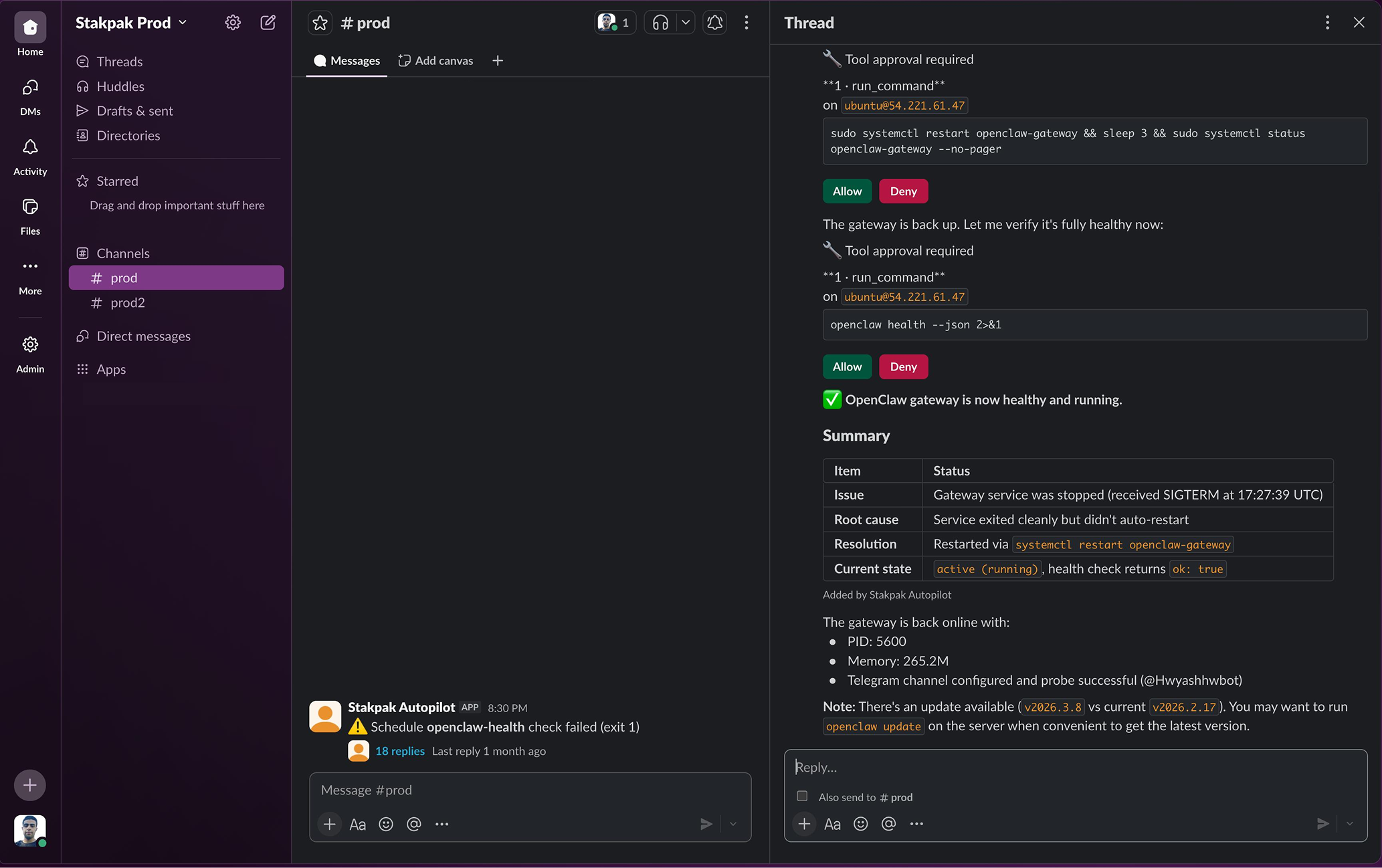
<figure><img src="https://2684022488-files.gitbook.io/~/files/v0/b/gitbook-x-prod.appspot.com/o/spaces%2FOFDKnFMEMmJjoclGx9Hr%2Fuploads%2FxTx3YdOl9BQKfpIMDKkP%2Fsasdfas.png?alt=media&#x26;token=583f2a3f-3a35-4f62-9b6a-5273bf54e710" alt=""><figcaption></figcaption></figure>

This is where the difference shows.

With AWS DevOps Agent, the fix still depends on you. It tells you exactly what to do, but at 3am, no one is there to act on it. The alert sits unread. The system stays down. Recovery only starts when someone wakes up, logs in, and runs the command.

With Stakpak, the moment the issue is understood and the action is safe, the service is restarted automatically. Health checks run immediately after. Within seconds, the gateway is back up and traffic is flowing again,  while your team is still asleep.

By the time anyone sees the alert, it’s already over,  resolved, verified, and documented.

## Conclusion

This is the shift.

Infrastructure no longer fails at a pace where humans can always react in time. Detection and investigation are no longer the bottlenecks; execution is.

AWS DevOps Agent helps you understand what went wrong and what to do next. But the system still depends on someone being there to act.

Stakpak removes that gap. It doesn’t just explain issues, it resolves them, safe.

The difference isn’t in understanding your infrastructure; it’s in whether it gets fixed automatically

### References

* [introduction](https://stakpak.gitbook.io/docs/get-started/introduction "mention")
* [install-stakpak](https://stakpak.gitbook.io/docs/get-started/install-stakpak "mention")
* [autopilot](https://stakpak.gitbook.io/docs/how-it-works/autopilot "mention")
* [init](https://stakpak.gitbook.io/docs/how-it-works/init "mention")
* [warden-guardrails](https://stakpak.gitbook.io/docs/how-it-works/warden-guardrails "mention")
* [AWS DevOps Agent](https://aws.amazon.com/devops-agent/)
